Commercial Roofers Near Me: How to Hire the Right Contractor in Sarasota & Manatee County
When you search for commercial roofers near me in Sarasota or Manatee County, you're looking for someone who can handle flat roofing systems, TPO or PVC membranes, complex penetrations, and stringent Florida Building Code requirements—not someone who nails down asphalt shingles on residential homes. The distinction matters because commercial and residential roofing operate under entirely different technical, legal, and financial frameworks. This guide breaks down what commercial roofers do differently, why those differences exist, why they matter in Florida's harsh environment, and how to vet a contractor before signing a contract.
Most property managers and HOA board members in Sarasota and Manatee County assume that hiring a commercial roofer is just a scaled-up version of hiring a residential roofer. It's not. The differences run deep—from design and materials to Florida Building Code compliance and contractor licensing—and getting it wrong can cost tens of thousands of dollars in premature failures or code violations. Commercial roofers near you aren't just bigger crews with bigger ladders. They're specialists operating under a completely different set of rules, using fundamentally different materials, and managing risks that residential contractors never encounter.
Critical Questions You Need Answered Before You Hire
Before you sign a contract with any commercial roofing company near you, get clear answers to these four questions. They will shape every decision that follows—from budget to timeline to how well your roof holds up through the next hurricane season.
- What licensing and insurance do commercial roofers in Florida actually need, and how do I verify it?
- Why is my commercial roof flat while residential roofs are pitched, and what does that mean for maintenance and repairs?
- What are the Florida Building Code requirements specific to commercial roofing in high-risk hurricane zones like Sarasota and Manatee County?
- How much should I expect to pay for commercial roofing services, and why is it more expensive than residential?
Key Findings
- Commercial roofers near you must hold a Florida Contractor's License (CCC#) and carry specialized commercial insurance; residential roofers do not need these credentials.
- Commercial roofs are flat or low-slope (designed to drain at ¼" per foot minimum) and use seamless membranes like TPO, EPDM, or PVC; residential roofs are steep-pitched and use asphalt shingles, tiles, or metal panels.
- Commercial roofing materials cost $5–$14 per square foot versus $4–$7 for residential asphalt shingles, reflecting material quality and installation complexity.
- In Florida, if more than 25% of a roof is repaired in 12 months, the entire roof system must be brought up to current building code—a critical compliance rule for commercial properties.
- Approximately 29% of commercial roof leaks occur at HVAC penetrations, making flashing expertise and preventive maintenance non-negotiable in your contractor choice.
Methodology
This guide synthesizes Florida Building Code requirements, roofing material specifications from industry standards (GAF, TPO manufacturers), and contractor licensing rules from the Florida Construction Industry Licensing Board. We've included cost comparisons from market data, structural differences between flat and pitched roof design, and real-world leak statistics from commercial roofing studies. Local context for Sarasota and Manatee County reflects hurricane-zone requirements (High-Velocity Hurricane Zones) and the region's specific UV exposure and moisture challenges. The framework prioritizes decision-making tools—comparisons, checklists, and verification steps—over generic roofing theory.
1. Commercial Roofers Near Me: What Makes Them Different from Residential Roofers
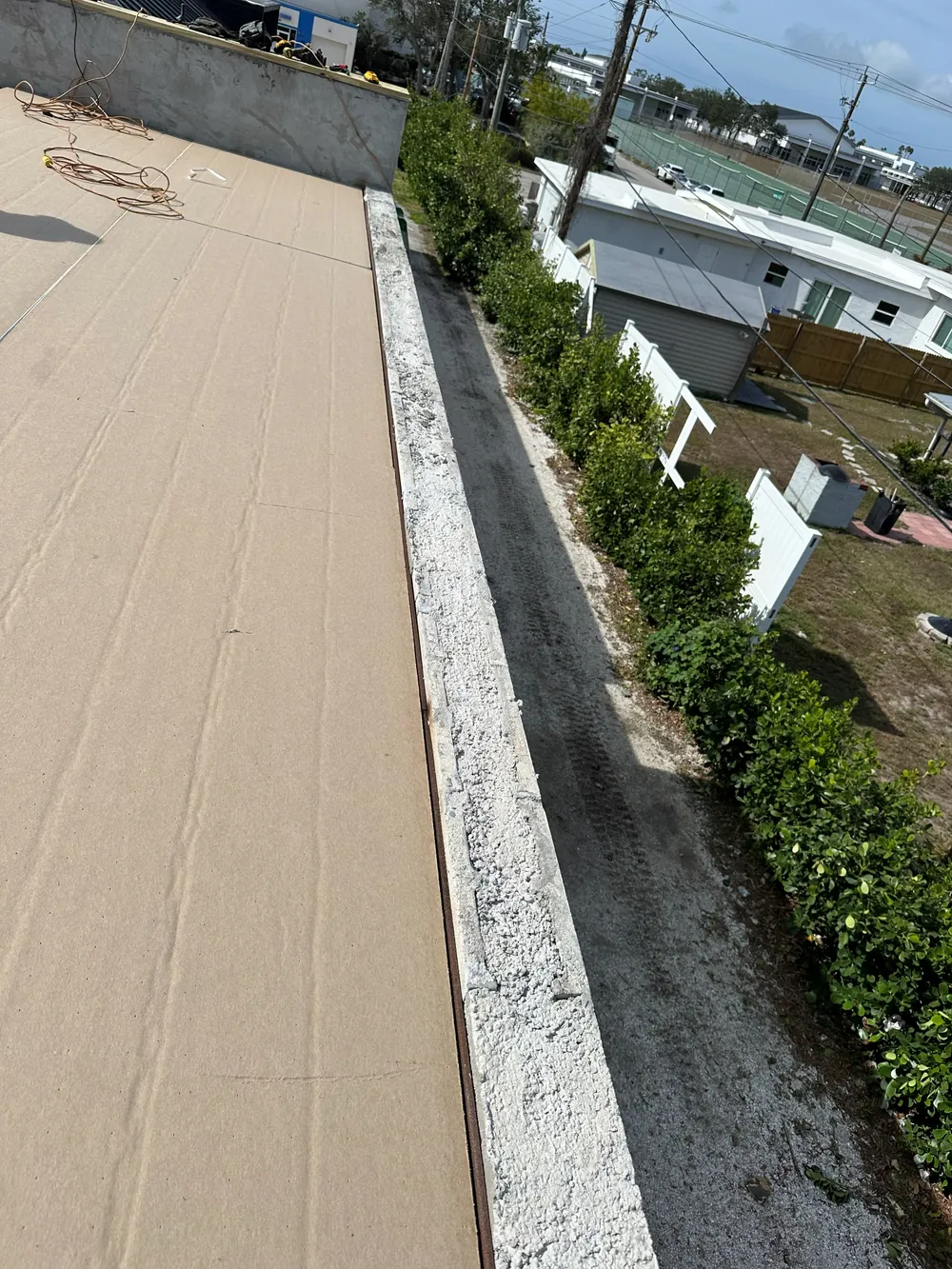
The first thing to understand is that "commercial roofer" isn't a marketing label—it describes a different skill set entirely. A commercial roof is almost always flat or low-slope, which changes everything about how water is managed. Instead of gravity pulling rain down a steep pitch and off the eaves, a flat roof has to be engineered to drain continuously across its surface, typically at a minimum of ¼ inch per foot. Get that slope wrong, or let it settle over time, and you get ponding water—one of the fastest ways to shorten a membrane's lifespan.
Materials diverge just as sharply. Residential roofers work with individual components: shingles, tiles, or metal panels fastened piece by piece, each one a potential entry point for water if installed poorly. Commercial roofers work with seamless membrane systems—TPO, EPDM, or PVC—that are heat-welded or adhered into a single continuous surface. The installation methodology, tools, and training required to do this correctly bear almost no resemblance to shingle work.
Licensing draws a hard legal line between the two. In Florida, commercial roofing work requires a Contractor's License (CCC#), along with commercial-grade insurance that residential-only roofers typically don't carry. This isn't bureaucratic overhead—it reflects the higher stakes of commercial projects, where a failure can affect dozens of tenants, an entire HOA community, or a business's ability to operate.
Timeline and scope tell the rest of the story. A residential reroof might wrap up in a few days. A commercial project spans weeks, involves coordinating around rooftop HVAC units, and requires sequencing multiple layers of insulation, cover board, and membrane. All of that complexity shows up in the final invoice, which is why commercial roofing services cost more per square foot than residential work—even before you factor in material quality.
Think of it this way: hiring a residential roofer for a commercial flat roof is like hiring a house painter to paint a skyscraper's exterior. The tools, techniques, scale, and regulations are fundamentally different. A residential roofer might handle a sloped shingled roof beautifully, but a commercial roofer is trained in membrane installation, complex penetrations, hurricane codes, and multi-week project coordination—skills that simply don't transfer from one trade to the other.
| Factor | Commercial Roofers | Residential Roofers |
|---|---|---|
| Roof Design | Flat or low-slope (¼" drop per foot minimum) | Steep-pitched (4:12 to 12:12 slope) |
| Primary Material | TPO, EPDM, or PVC seamless membranes | Asphalt shingles, tiles, or metal panels |
| Florida License Required | Yes—Contractor's License (CCC#) mandatory | Not always; some residential work exempt |
| Installation Time | Weeks (multi-layer system, HVAC coordination) | Days (straightforward shingle application) |
| Penetration Complexity | Multiple HVAC units, vents, skylights; high leak risk | Single chimney, exhaust vent; simpler flashing |
| Cost per Square Foot | $5–$14 (material + labor complexity) | $4–$7 (standard material cost) |
| Best for | Office buildings, shopping centers, warehouses, HOA common areas | Single-family homes, townhouses, small residential |
- A commercial roofer can often perform residential work (with proper licensing), but a residential-only contractor cannot legally take on commercial projects in Florida.
- The "flat" roof design doesn't mean zero slope—it must drain continuously to prevent ponding water, which causes leaks, ice dams (in rare cold snaps), and membrane deterioration.
2. Commercial Roofing Materials and Florida Weather: Why TPO and PVC Dominate in Sarasota & Manatee County
Florida's climate is unforgiving on roofing systems—intense UV radiation for most of the year, high humidity that never really lets up, and a hurricane season that tests every seam and fastener. This is exactly why seamless membranes have become the default choice for commercial roofing services in this region, rather than an incidental preference.
TPO and PVC membranes are thermally welded together, creating joints with zero gaps—a stark contrast to a shingled roof, which has thousands of individual overlaps and nail penetrations, each one a theoretical weak point. On a commercial building, where the roof deck spans tens of thousands of square feet, minimizing the number of potential failure points isn't a luxury; it's the entire design philosophy.
Durability is the other half of the equation. A well-installed commercial membrane system is expected to last 15 to 20-plus years, compared to 10 to 15 years for residential asphalt shingles under similar Florida sun exposure. White TPO and PVC membranes also reflect a significant portion of solar radiation, which keeps the roof surface cooler, reduces thermal cycling stress on the membrane, and helps lower the building's cooling load.
Wind performance matters just as much as heat performance here. Because Sarasota and Manatee County sit within Florida's High-Velocity Hurricane Zone requirements, commercial membrane systems have to meet enhanced uplift standards that asphalt shingles were never designed to satisfy. And because humidity never fully disappears in this part of the state, membrane systems' resistance to moisture intrusion and mold growth underneath the roofing layer becomes a practical, everyday concern—not a theoretical one.
- TPO (thermoplastic olefin) and PVC (polyvinyl chloride) are thermally welded together, creating seamless joints with zero gaps—unlike shingled roofs with thousands of potential leak points.
- EPDM (ethylene propylene diene monomer) is popular for older commercial buildings in Sarasota, though TPO and PVC offer better UV performance and are preferred for new construction.
- Single-ply membranes can be inspected, maintained, and partially repaired without replacing the entire roof—a major cost advantage over time.
3. Florida Building Code Requirements for Commercial Roofs: Understanding HVHZ Rules and Code Compliance
Every commercial roof in Sarasota and Manatee County has to satisfy a stack of Florida Building Code requirements that go well beyond "keep the rain out." The minimum slope requirement—¼ inch per foot—exists specifically so flat roofs drain instead of pooling water on top of the membrane. Class A fire rating requirements dictate which membrane assemblies are even eligible for installation on a given building type. And wind uplift resistance standards are especially demanding along the coast, where High-Velocity Hurricane Zone classification pushes performance requirements well above what's required inland.
The rule that catches the most property managers off guard, though, is the 25% repair threshold. If more than a quarter of your roof gets repaired within a 12-month window—whether from one major storm event or from a string of smaller commercial roof repairs that add up—Florida code requires the entire roof system to be brought up to current standards. That's not a minor line item. It can mean replacing sections of a roof that were otherwise fine, purely because the code treats extensive repair as equivalent to a full renovation trigger.
This threshold has real financial teeth. Insurance carriers and lenders both check for code compliance, and a violation surfacing during a claim review or a refinance can result in a denied claim or a lender-mandated full roof replacement before the deal closes. A commercial roofer who understands Sarasota and Manatee County code specifics can flag compliance gaps proactively—well before they become an emergency discovered at the worst possible moment.
- High-Velocity Hurricane Zone (HVHZ) classification for coastal Sarasota and Manatee County means your commercial roof must meet enhanced wind uplift performance—typically 90+ PSF (pounds per square foot).
- A code violation discovered during an insurance claim or property inspection can result in claim denial or a lender mandate to replace the entire roof before refinancing.
- Commercial roofers near you who are familiar with Sarasota and Manatee County codes can identify compliance gaps and recommend upgrades proactively, saving you thousands in emergency repairs.
4. How to Vet Commercial Roofers Near Me: Licensing, Insurance, and Qualifications in Florida
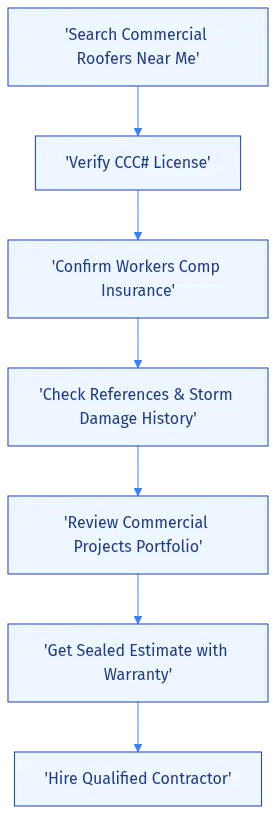
Once you understand what separates commercial roofing contractors from residential ones, vetting becomes a lot more concrete. Start with the license. Every commercial roofer working in Florida is required to hold an active CCC# issued by the Construction Industry Licensing Board, and that status is publicly searchable. Never take a contractor's word for it—look it up yourself before any conversation about pricing.
Insurance is the second non-negotiable. A legitimate commercial roofing company near you should carry a minimum of $1M in general liability coverage plus workers' compensation insurance covering every crew member who sets foot on your roof. Ask for a Certificate of Insurance (COI) that names your property as an additional insured—this is standard practice, and any contractor who hesitates to provide one should raise a flag.
References matter more in commercial work than almost anywhere else in this industry, because scope and materials vary so much by building type. Ask for at least three references from commercial clients completed within the past three years, and don't just ask "were you happy?" Ask about communication cadence, whether the timeline held up, and what post-installation support looked like once the crew left the site.
Storm damage expertise deserves its own line of questioning. A roofer who regularly handles hurricane damage claims will know how to document damage properly, coordinate with adjusters, and avoid the kind of underinsured shortcuts that leave property owners exposed later. Finally, look closely at warranty offerings—material and labor coverage length, and whether the warranty transfers if the property changes ownership, all matter for long-term asset value.
- The Florida Construction Industry Licensing Board (CILB) maintains a public database at flhealthsource.gov; search by name, license number, or company to verify active status and any disciplinary history.
- A commercial roofer should carry a minimum of $1M general liability insurance and workers' compensation insurance covering all crew members. Ask for a Certificate of Insurance (COI) naming your property as an additional insured.
- Request at least three references from commercial clients (not residential) completed in the past 3 years, and ask specifically about communication, timeline adherence, and post-installation support.
5. Commercial Roof Leak Prevention: Why HVAC Penetrations and Flashing Are Your Biggest Risk
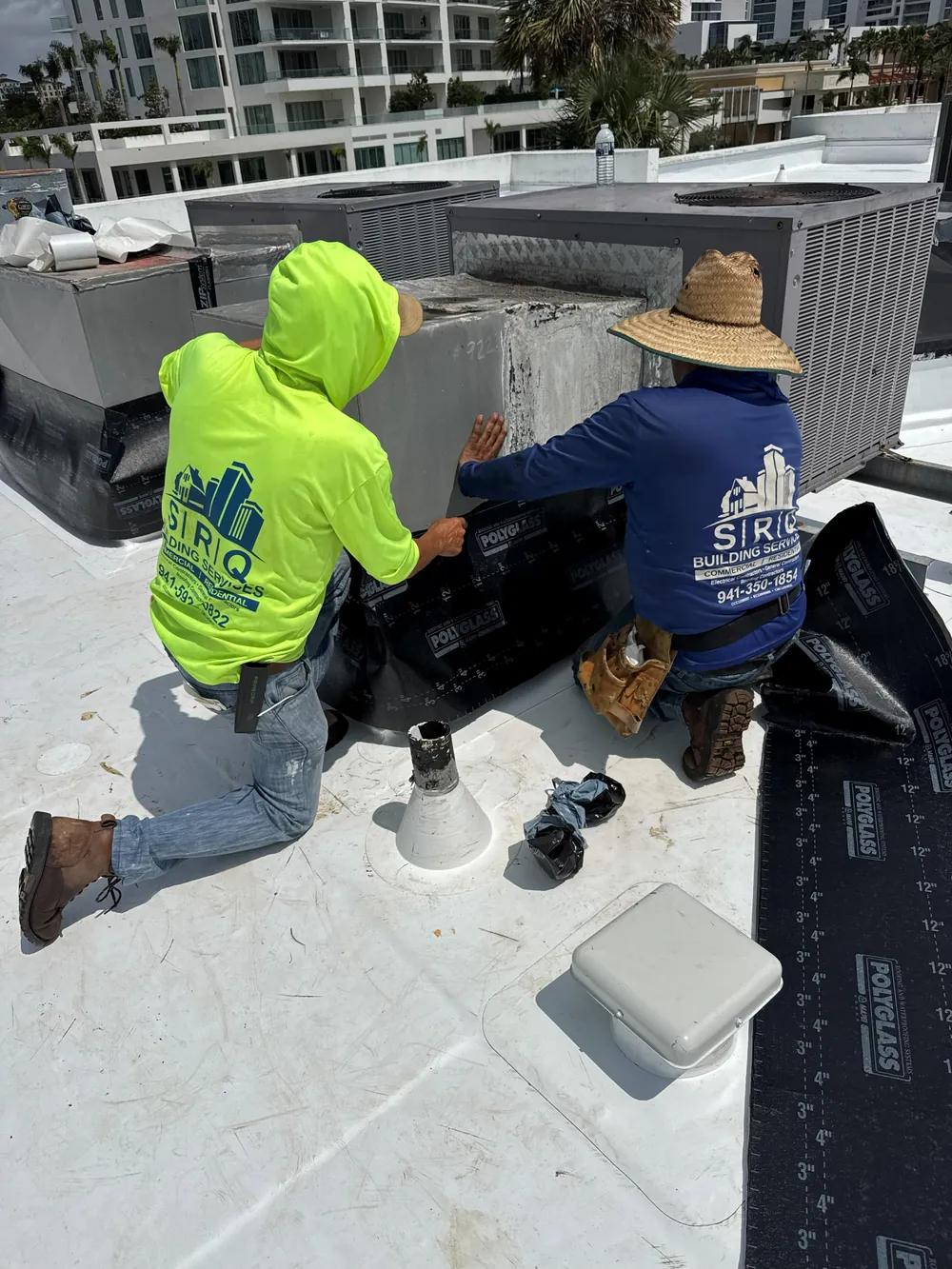
If there's one detail worth obsessing over on any flat commercial roof, it's the flashing around HVAC equipment. Every rooftop unit, vent, and skylight is a penetration through the membrane, and each one relies on flashing—not the membrane itself—to keep water out. When flashing fails, water doesn't announce itself immediately. It seeps in slowly, tracking along structural members before it ever shows up as a stain on a ceiling tile.
Best-practice flashing installation uses boot-style details around equipment legs and curbs, with sealant applied and integrated directly into the membrane system rather than layered on top as an afterthought. This is exactly the kind of detail work that separates a rushed installation from one built to last. Preventive maintenance—quarterly visual inspections, sealant reapplication on a set schedule, and prompt attention to early warning signs—is what keeps small issues from becoming five-figure interior repairs.
Visual signs of failing flashing are usually visible before a leak ever reaches the interior: discoloration around penetrations, membrane separation at the seams, or corrosion on metal flashing components. Catch these early, and a repair is inexpensive. Ignore them, and you're looking at interior water damage, mold growth inside ceiling cavities, and potentially structural rot—problems that also complicate insurance claims down the line.
Consider how this plays out in practice. A Sarasota HOA discovers water stains inside the clubhouse ceiling during a routine walk-through. The property manager calls three local roofers: one is residential-only and declines the job outright; the second offers a cheap estimate of $2 per square foot with no warranty attached; the third—a licensed commercial roofer—visits the roof, identifies a failed HVAC flashing seal (the most common leak source on flat roofs), documents it with photos, and recommends a preventive maintenance plan with annual inspections. Though slightly more expensive upfront, the third roofer prevents a costly interior mold problem and extends the roof's remaining useful life by years. The HOA chooses the qualified commercial roofer—and avoids a much larger bill down the road.
- The most common mistake commercial property managers make is delaying repairs to small flashing separations, thinking "it's not urgent." By the time a leak is visible inside, structural damage is often underway.
- A qualified commercial roofer should offer annual or semi-annual roof inspections as part of a maintenance plan—far cheaper than emergency repairs or claims disputes.
- Sealant around HVAC penetrations requires reapplication every 3–5 years in Florida's UV-intense, humid climate; this is a routine, inexpensive maintenance task that prevents expensive leaks.
6. Commercial Roofing Cost Breakdown: Why Initial Investment Pays Off in Long-Term Durability
The sticker shock of commercial roofing quotes usually comes down to two things: material grade and installation complexity. TPO, EPDM, and PVC membranes cost more per square foot than asphalt shingles because they're engineered for a completely different performance standard—UV resistance, seamless waterproofing, and multi-decade durability. Labor adds to that gap: commercial crews need specialized training for membrane welding, safety protocols for rooftop work around HVAC equipment, and the coordination skill to sequence a multi-week installation without disrupting building operations.
Run the numbers over a full lifecycle, though, and the picture shifts. A commercial system installed today with a 15 to 20-plus year expected lifespan compares favorably against residential shingles that typically need replacement every 10 to 15 years. Property managers who budget for that longer horizon—rather than treating the roof as a near-term expense—tend to make smarter capital planning decisions, particularly for HOAs managing reserve funds across a 30-year holding period.
Financing structure matters here too. Many HOAs and property managers build roofing costs into multi-year reserve fund schedules rather than treating a reroof as a surprise expense. And there's a compliance upside worth mentioning: a code-compliant commercial roof, properly documented, can support better insurance terms and smoother lender approval during refinancing—two things that matter just as much as the roof itself when you're managing a commercial asset.
- A 10,000 sq ft commercial roof costs $50,000–$140,000 in materials and labor; a 2,000 sq ft residential roof costs $8,000–$14,000. Scale and complexity drive the difference.
- Commercial property managers who budget for a 15–20 year roof lifespan versus replacing residential shingles every 10–12 years save significantly over a 30-year holding period.
- Some commercial roofers near you offer extended warranties (10–15 years labor + 20–25 year material) backed by manufacturer guarantees; ask for warranty details in your estimate.
What This Means for You
- Property managers and HOA board members must prioritize hiring licensed, insured commercial roofers for flat-roof projects to ensure Florida Building Code compliance, avoid insurance claim denials, and protect the building's structural integrity.
- Commercial roofing represents a significant capital investment, but treating it as a 15–20 year asset (not a 5-year expense) shifts the decision-making calculus toward higher-quality materials and preventive maintenance over time.
- Tenants in commercial buildings (office, retail, warehouse) depend on a leak-free roof for interior comfort, inventory protection, and operational continuity—making contractor vetting a priority that affects tenant relations and lease renewals.
- The 25% FBC rule means a single catastrophic event (hurricane, hail) or years of deferred maintenance can trigger a mandatory full-system code upgrade, costing $50,000–$200,000+. Preventive maintenance and early repairs are cost-control strategies that also protect asset value.
- Sarasota and Manatee County's HVHZ classification and intense UV exposure make roofing decisions uniquely local; hiring a commercial roofer familiar with the region's specific code requirements, weather patterns, and material performance is non-negotiable.
Keep Learning
- Roof Fixers Near Me: A Pre-Arrival Checklist for a Faster Fix — Before a roofing contractor arrives, prepare your property and documentation to streamline inspection and speed up diagnosis—especially critical for commercial emergency repairs.
- Storm Damage Roof Repair Near Me: Sarasota & Manatee County Homeowner's Guide — After a hurricane or severe weather event, understand the steps to document damage, work with insurance, and hire qualified contractors—principles that apply to both residential and commercial properties.
- What a Roof Inspection Actually Covers in Sarasota, FL | Complete Guide — Learn what a professional inspection includes, how to recognize warning signs of failing roofs (especially flashing and penetrations), and when to call for repairs before small leaks become emergencies.
Frequently Asked Questions
How do I know if a roofer is qualified to work on commercial buildings in Sarasota or Manatee County?
Check for an active Florida Contractor's License (CCC#) through the Construction Industry Licensing Board's public database, and confirm they carry commercial general liability and workers' compensation insurance. If a contractor hesitates to provide either, treat that as a red flag and keep looking.
Why does my flat commercial roof need to be replaced sooner than expected after storm repairs?
Florida Building Code requires that if more than 25% of a roof is repaired within 12 months, the entire roof system must meet current code standards. This can turn what seemed like a minor repair into a full-system upgrade, which is why early intervention and preventive maintenance matter so much.
Is TPO or PVC better for a commercial roof in Florida's climate?
Both perform well in Florida's UV and humidity conditions, with PVC generally offering slightly stronger chemical and grease resistance and TPO offering strong overall value. The right choice depends on your building's specific exposure, rooftop equipment, and budget—your commercial roofer should walk you through the tradeoffs for your property.
How often should a commercial roof be inspected to prevent leaks?
Most commercial roofing contractors recommend at least semi-annual inspections, with additional checks after major storms. Given that a large share of commercial leaks start at HVAC penetrations, paying close attention to flashing and sealant condition during each inspection is essential.
Why is commercial roofing so much more expensive than residential roofing?
Commercial roofs use higher-grade seamless membrane materials, require specialized welding and installation techniques, and involve coordinating around HVAC equipment and multi-week timelines. That complexity, combined with a longer expected lifespan of 15 to 20-plus years, is what drives the higher per-square-foot cost compared to residential asphalt shingles.