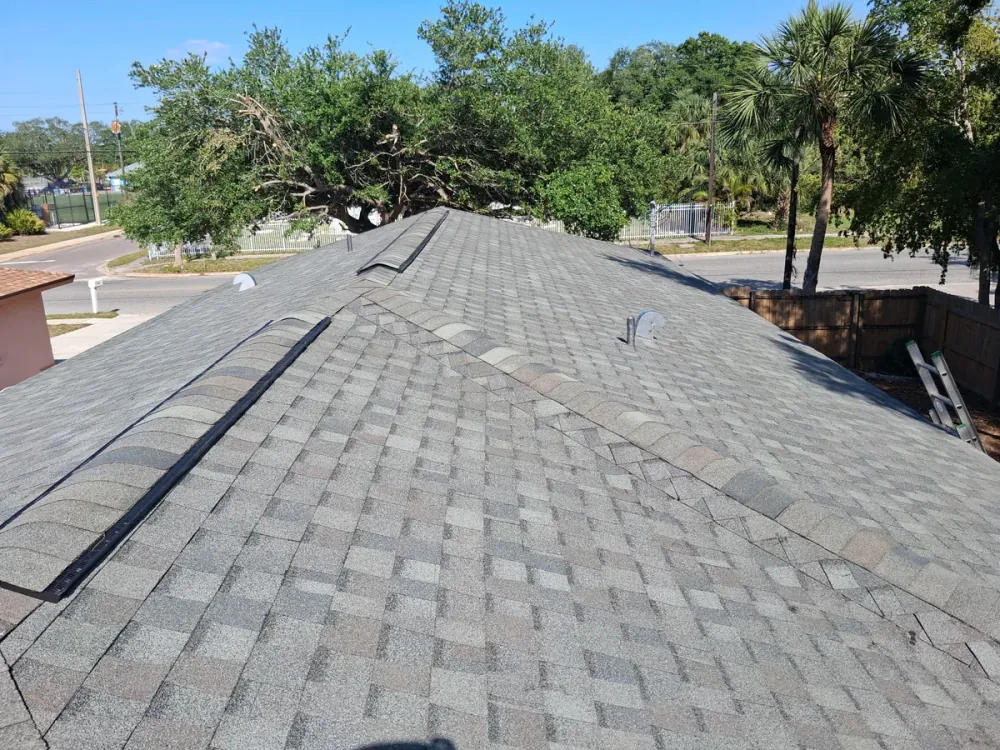

Florida Asphalt Shingles: Lifespan, Wind Codes & Durability in Sarasota & Manatee
When you search for information about asphalt shingles in Florida, you'll find plenty of national averages. But if you own a home in Sarasota or Manatee County—or manage a multi-unit property there—those numbers don't reflect your reality. Asphalt shingles face a perfect storm of stressors: relentless UV radiation, Gulf humidity, surface temperatures that rival an oven, and the code-mandated wind resistance that new construction must meet. This guide breaks down exactly how asphalt shingles age in Florida, what the building code actually requires, when you can repair versus when you must replace, and why your insurance company cares about dates far more than durability.
Most Florida homeowners believe their asphalt shingle roof will last 25–30 years because that's what the manufacturer's warranty says. In reality, the intense UV exposure, 150°F surface heat, and daily thermal cycling of Sarasota and Manatee's coastal climate cuts that lifespan by one-third—and insurance companies know it. The difference between a roof that survives a Category 4 hurricane and one that fails during the storm isn't just the shingle type; it's whether you understand Florida's stricter wind codes, the secondary water barrier your roofer may have skipped, and the insurance "clock" that ticks faster than you think.
The Questions Every Sarasota & Manatee Homeowner Asks
- How much faster do asphalt shingles degrade in Florida's climate compared to northern climates, and why?
- What wind rating does the Florida Building Code demand, and do standard asphalt shingles meet it?
- When does the Florida Building Code allow repair of asphalt shingles, and when is full replacement mandatory?
Key Findings
- Architectural asphalt shingles lose approximately one-third of their typical lifespan in Florida (15–20 years vs. 25–30 years in temperate climates) due to UV intensity, thermal cycling, and Gulf humidity.
- The Florida Building Code requires ASTM D7158 Class H wind resistance (up to 150 mph gusts) in coastal Sarasota and Manatee; standard 3-tab shingles (60–70 mph) do not comply.
- Insurance companies impose mandatory inspections and potential non-renewal at the 15-year mark, creating a hard deadline that often arrives before physical failure.
- Architectural shingles resist significantly more wind than 3-tab shingles (130 mph vs. 65 mph) and last 5–10 years longer in Florida, making them the default choice for compliance and durability.
- The secondary water barrier (peel-and-stick membrane) and proper 6-nail fastening per shingle account for roughly half of hurricane survival outcomes; shingle grade alone is insufficient.
This guide synthesizes Florida Building Code (FBC) requirements, ASTM standards (D7158, D3161), data from Integrity Roofing and InterNACHI, and guidance from the Florida Office of Insurance Regulation (OIR). We focus on asphalt shingles because they account for roughly 80% of residential roofs in Sarasota and Manatee County. Information is current to early 2026 and reflects coastal subtropical conditions; inland properties may see slightly longer shingle life. Wind ratings reflect 3-second gust speeds; installation quality and maintenance directly affect real-world durability.
1. Why Asphalt Shingles Fail Faster in Florida Than National Warranties Suggest
Surface temperatures on a Florida roof regularly exceed 150°F during summer afternoons. At that temperature, the asphalt binder—the sticky compound that holds the shingle mat together—becomes soft and plastic, almost gelatinous. It flows slightly under its own weight, and the factory-applied sealant strips that are supposed to lock shingles together start to fail years earlier than they would in a cooler climate.
Then there's the daily whiplash. A roof deck can swing from 150°F at 3 p.m. to under 80°F overnight, a temperature swing of 100°F or more within hours. That constant expansion and contraction causes micro-fracturing in the shingle mat and curling at the edges and corners—the classic signs of a Florida roof nearing the end of its useful life.
UV radiation compounds the damage. It breaks down the polymer chains in the asphalt, and once the protective granule coating starts shedding—typically beginning around year 7 to 10 in Florida versus year 12 or later up north—the bare asphalt underneath is exposed directly to sunlight. From that point, degradation accelerates rapidly rather than gradually.
Add Gulf humidity and salt air into the mix, and you get corrosion of fasteners and faster moisture penetration into the roof substrate. The result: warranty guarantees become largely irrelevant once insurers start imposing their own replacement deadlines, often well before the shingle has physically failed.
Think of an asphalt shingle like a chocolate bar left in the sun. In a cool room—comparable to a temperate climate—it slowly hardens and cracks over years. In a hot car, comparable to a Florida roof deck, it melts, hardens into a brittle shell, and falls apart in a fraction of the time. The granules are the wrapper protecting the chocolate (the asphalt binder); once that wrapper tears and granules shed, the binder bakes unprotected and fails fast. The 15-year insurance clock works like a store's expiration date—it doesn't care if the chocolate still looks half-edible. It's off the shelf at day 365, whether or not it still looks fine from the street.
- Thermal stress cycles: A shingle that sees 150°F surface temps in July and 70°F in winter undergoes roughly 30 major thermal cycles per year, compared to about 10 in northern climates.
- Granule loss: In Florida, visible granule loss begins year 5–7; in temperate zones, year 12+. Bare asphalt exposed to UV degrades exponentially faster once this starts.
- Sealant failure: Manufacturer sealant strips that bond shingles in overlaps fail by year 10–12 in Florida; in cool climates, year 15–18 is typical.
If you're trying to figure out whether your current roof is simply weathered or actually failing, it helps to get a second opinion from someone who understands how to vet local roofers who understand Florida's unique climate before you make any decisions about repair or replacement.
| Ubicación | Vida útil real promedio | Factor de degradación |
|---|---|---|
2. Asphalt Shingle Roof Wind Ratings and Florida Building Code Compliance
The Florida Building Code, Section 1507, requires ASTM D7158 Class H wind resistance for coastal counties, and Sarasota and Manatee both fall squarely in that zone. Class H means the roofing material has to be tested to withstand wind speeds up to 150 mph in gust form—a standard that exists precisely because this region takes direct hurricane hits.
Here's the uncomfortable truth: standard 3-tab shingles max out around 60–70 mph. That's not close. Architectural (laminated) shingles do better, typically rated between 120–130 mph, but even that falls short of the 150 mph Class H threshold on their own. To actually reach code compliance, architectural shingles need to be paired with a secondary water barrier and proper fastening—specifically, 6 nails per shingle instead of the 4 that are common in cheaper installations.
This is a critical point that gets lost in shingle marketing: wind-resistant shingles alone do not guarantee survival. Installation quality and deck preparation determine how a roof actually performs in real wind, not just the rating printed on the shingle wrapper. A Class H-rated shingle installed with shortcuts behaves more like a lower-rated product once the wind actually arrives.
Roof age matters for compliance too. Shingles that were Class H compliant when installed can lose that wind resistance as they age past 15 years—granule loss, brittle mat material, and degraded sealant strips all reduce real-world wind performance even though the original rating never officially changes on paper.
- ASTM D3161 Class F impact resistance (hail/debris): Most architectural shingles meet this; 3-tab shingles typically do not.
- Installation detail: A single shingle fastened with 4 nails instead of 6 reduces wind resistance by roughly 15–20%; roofer shortcuts compound risk across the whole roof.
- Re-roofing code: If replacing only part of your roof due to storm damage, new shingles must meet current FBC (Class H), not the original roof's rating.
3. Architectural vs. 3-Tab Asphalt Shingles: Performance and Longevity in Florida
The construction difference between 3-tab and architectural shingles explains most of the performance gap. 3-tab shingles are single-layer products; architectural shingles are laminated, with overlapping layers that resist wind lift and impact far better. When wind gets under a 3-tab shingle, there's nothing else holding that section down. Architectural shingles have a second layer bonded beneath, so even if the top layer lifts slightly, the roof retains more coverage.
Architectural shingles also typically use modified asphalt—often SBS (styrene-butadiene-styrene) or APP (atactic polypropylene) polymer-modified—that stays flexible in extreme heat rather than hardening and cracking the way standard asphalt does. This flexibility is the main reason architectural shingles tolerate Florida's thermal cycling noticeably better than 3-tab products.
Granule retention follows the same pattern. The thicker substrate and adhesive formulation in architectural shingles slow granule shedding by roughly 3–5 years compared to 3-tab shingles, which means the protective layer over the asphalt binder lasts longer before UV starts attacking it directly.
There's also a resale and HOA angle worth mentioning: architectural shingles mimic the look of slate or wood shake, which tends to appeal to buyers and satisfy stricter HOA architectural standards common across Sarasota and Manatee neighborhoods.
- Impact resistance: CertainTeed Landmark Pro and similar lines with SBS polymers can withstand impact equivalent to hail up to 1.5-inch diameter, versus 1-inch for standard 3-tab shingles.
- Curl and edge lifting: Architectural shingles' self-sealing mechanism holds through more heat cycles; 3-tab edges lift and curl within 5–8 years in Florida.
- Reroofing over existing roof: Architectural shingles add 2–3 lbs/sq ft; a 3-tab base can typically handle one additional layer, but code often requires tear-off and deck inspection anyway.
| Attribute | 3-Tab Shingles | Architectural Shingles | Verdict for Florida |
|---|---|---|---|
| Wind Resistance | 60–70 mph | 120–130 mph | Architectural required; 3-tab violates FBC in coastal zones |
| Expected Lifespan in Florida | 10–15 years | 15–20 years | Choose architectural for 25–50% longer life |
| UV & Thermal Cycling Tolerance | Poor; rapid granule loss | Better; modified asphalt resists stress | Architectural delays visible wear by 5+ years |
| Cost (per-square installation) | $150–250 | $200–350 | Architectural costs ~30–40% more; justifies itself in durability |
| Sealant Strip Durability | Fails by year 10–12 | Fails by year 12–15 | Both fail fast in FL heat; architectural margin slightly higher |
| Insurance Acceptability at 15 years | Likely non-renewal or surcharge | Inspection may pass if well-maintained | Architectural has slight edge; neither guarantees insurable |
| Best for / When to Choose | Budget-conscious, short-term rental, or northern climates | Permanent owner-occupied, FBC compliance required, hurricane-prone zones | Architectural is the smart default for Sarasota/Manatee |
If you're currently comparing contractors, it's worth understanding finding roofers experienced in architectural shingle installation and Florida wind standards, since the installation quality matters as much as the shingle itself.
4. Asphalt Shingle Roof Repair vs. Replacement: Florida Building Code Rules
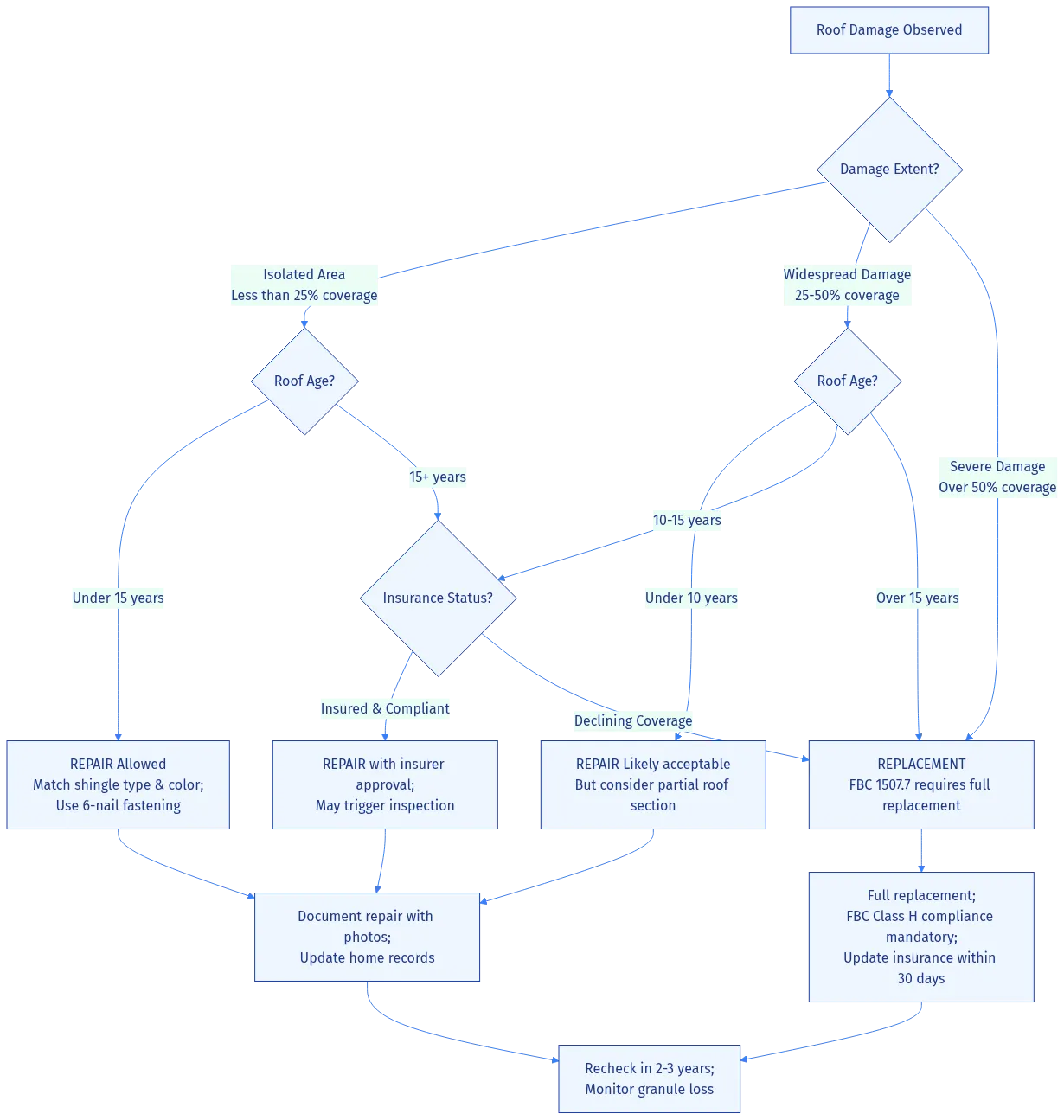
FBC Section 1507.7.1 lays out a fairly clear framework: isolated damage, generally under 25% of the roof surface, can be repaired. Widespread damage in the 25–50% range requires a licensed roofer's evaluation before deciding on repair versus replacement. Anything beyond that threshold typically triggers mandatory full replacement under code.
But physical damage isn't the only factor in play. What we call the "15-year insurance clock" often overrides the FBC's repair allowances entirely. Many insurers won't renew a policy—or will require a passing replacement-level inspection—regardless of whether the Building Code would technically permit a repair.
When repairs are allowed, the replacement shingles must match the existing roof's type, color, and profile—architectural matched to architectural, 3-tab matched to 3-tab—or the contractor has to replace a larger section to maintain a uniform appearance and performance. Fastening rules apply here too: repair shingles must use the FBC minimum of 6 nails per shingle, even if the original roof was installed with only 4.
Permitting requirements vary by municipality. Minor repairs under 100 square feet may not require a permit in some parts of Sarasota or Manatee County, but storm damage repairs typically do, especially if the work involves decking or flashing.
Less than 25% coverage| C{Roof Age?}; B -->|Widespread Damage
25-50% coverage| D{Roof Age?}; B -->|Severe Damage
Over 50% coverage| E[REPLACEMENT
FBC 1507.7 requires full replacement]; C -->|Under 15 years| F[REPAIR Allowed
Match shingle type & color;
Use 6-nail fastening]; C -->|15+ years| G{Insurance Status?}; D -->|Under 10 years| H[REPAIR Likely acceptable
But consider partial roof section]; D -->|10-15 years| G; D -->|Over 15 years| E; G -->|Insured & Compliant| I[REPAIR with insurer approval;
May trigger inspection]; G -->|Declining Coverage| E; F --> J[Document repair with photos;
Update home records]; H --> J; I --> J; E --> K[Full replacement;
FBC Class H compliance mandatory;
Update insurance within 30 days]; J --> L[Recheck in 2-3 years;
Monitor granule loss]; K --> L;
- Partial roof replacement: If you replace 30–40% of the roof, FBC may require the entire roof to meet current Class H wind standard, though this is not necessarily retroactive to existing shingles under 15 years old.
- Deck inspection: If shingles are removed for repair, the deck (plywood/OSB) must be inspected for rot or structural damage; insurance or lenders may require replacement if issues are found.
- Secondary water barrier: FBC 1507.8.7 mandates a secondary water barrier (peel-and-stick) on all new installations and all repairs in flood zones; confirm your contractor includes it.
- Color matching: Shingles weather and fade; exact matching after year 5+ is difficult, so consider replacing larger sections for aesthetic consistency.
Before any inspector or contractor shows up to assess storm damage, it helps to use a pre-arrival checklist to document damage before a roofer's inspection, which can speed up both the repair decision and any insurance claim.
5. Best Asphalt Shingle Brands for Florida: CertainTeed, Polymer-Modified, and Emerging Alternatives
SBS polymer modification adds elasticity to the asphalt mat, letting shingles remain flexible at 150°F surface temperatures instead of hardening and cracking the way standard asphalt products do. APP modification offers strong UV resistance and shows up frequently in coastal product lines, though it's marginally more brittle in extreme cold—a non-issue in Florida.
Among CertainTeed roofing shingles, the Landmark Pro line has become something of a default choice across Sarasota and Manatee because of its strong sealant performance and proven track record in heat-humidity cycling, combined with local roofer familiarity that makes warranty claims and repairs more straightforward.
Metal shingles—steel, not aluminum—are worth a mention as an alternative. They offer a 30–40-year lifespan and exceed 140 mph wind ratings, but the cost premium is steep, often landing well above traditional asphalt installed cost. Some manufacturers are also introducing reflective-coated asphalt shingles designed to reduce surface temperatures by 10–15°F; that cooling effect can translate into a modest 2–3 year lifespan extension, though adoption is still limited in the region.
- Warranty red flag: A manufacturer warranty doesn't equal insurance acceptability. A 30-year warranty on asphalt shingles doesn't prevent insurer non-renewal at the 15-year mark.
- Reflective (cool roof) shingles: Energy Star certified options reduce air conditioning load by roughly 5–10%; not yet widespread in Florida but growing. Ask your roofer about availability.
- Recycled content: Some CertainTeed and Owens Corning lines use post-consumer recycled asphalt, reducing environmental impact without sacrificing performance.
- Installation warranty: CertainTeed and GAF offer enhanced warranties (for example, 50-year non-prorated coverage) only if installed by a certified contractor; confirm certification before hiring.
| Brand / Product Line | Base Material & Upgrade | FBC Class H Rated? | Estimated FL Lifespan | Key Advantage | Cost Premium vs. 3-Tab |
|---|---|---|---|---|---|
| CertainTeed Landmark Pro | Fiberglass + SBS polymer-modified asphalt | Yes (120 mph base; 150 with secondary barrier) | 16–20 years | SBS flexibility resists thermal stress; strong sealant | +35% |
| GAF Timberline HD | Fiberglass + enhanced adhesive & granules | Yes (130 mph) | 15–19 years | Dual adhesion zones; limited lifetime warranty | +30% |
| Owens Corning Duration | Fiberglass + patented sealant | Yes (130 mph) | 15–18 years | 3-layer protection; proven in Florida market | +25% |
| IKO Armorglass | Fiberglass + APP polymer modification | Yes (optional Class H with reinforcement) | 14–17 years | Good UV resistance; excellent for salt-air exposure | +20% |
| Metal shingles (steel stain shingle) | Galvanized/coated steel stamped shingle profile | Yes (140+ mph) | 30–40+ years | Mimics traditional shingle look; exceeds wind rating | +60–100% |
| Standard 3-Tab (any brand) | Fiberglass + basic asphalt | No (60–70 mph only) | 10–15 years | Budget option; does not meet FBC coastal requirement | Baseline |
6. Secondary Water Barriers, 6-Nail Fastening, and Installation Details That Affect Durability
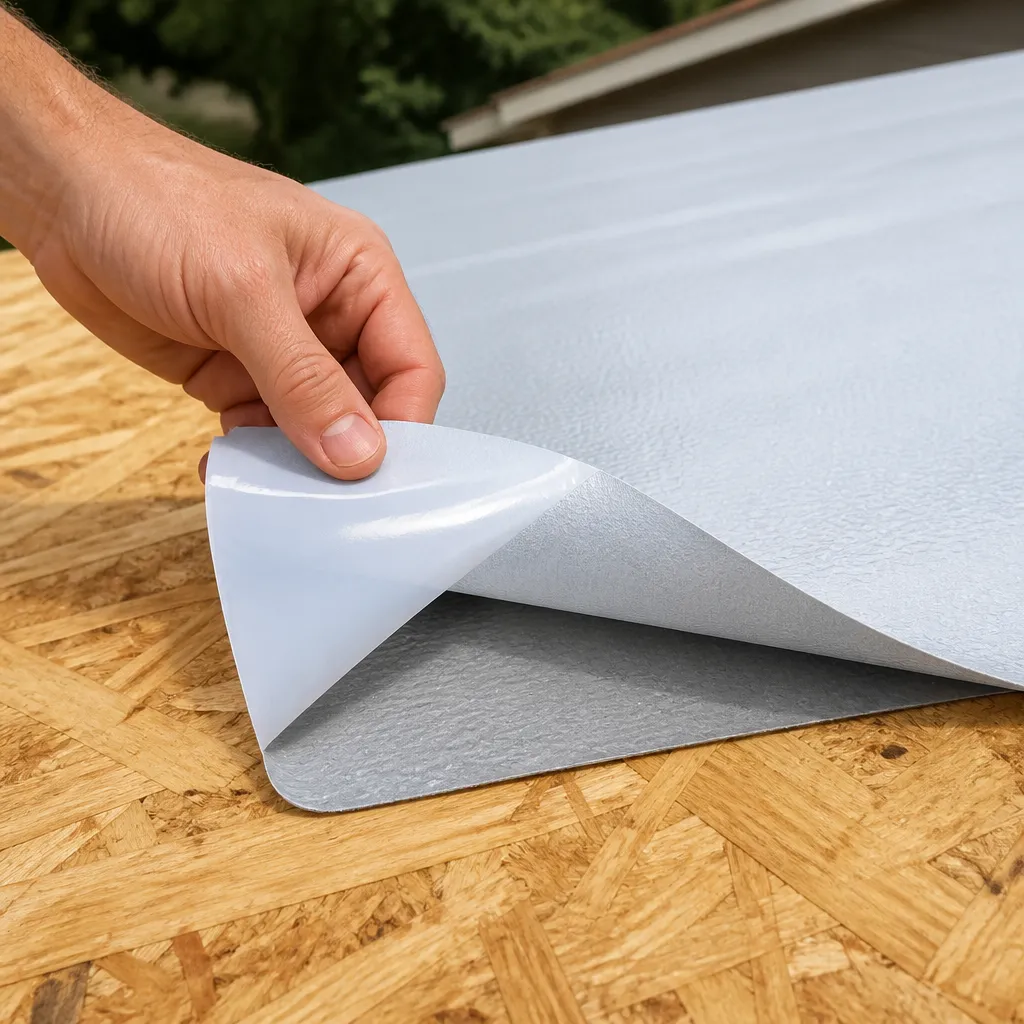
The secondary water barrier—a peel-and-stick membrane meeting ASTM D1970—is installed directly on the roof deck before any shingles go down. Its job is simple but critical: catch wind-driven rain that gets past the shingle layer during a hurricane, which happens more often than most homeowners realize.
FBC 1507.8.7 mandates this barrier on all new installations and coastal repairs, yet many older roofs—particularly those built before 2010—lack this layer entirely. That's a major, often invisible vulnerability heading into hurricane season.
Fastening matters just as much. The code calls for 6 nails per shingle: 4 above the seal strip and 2 in the upper corners, with each nail penetrating the decking at least 1.25 inches. If the deck is plywood, nails need to hit joists or rafters, typically spaced 16 inches on center; OSB decking allows more flexibility in nail placement as long as the barrier is properly sealed around each penetration.
The starter strip detail at the eave is another commonly overlooked step. That first course of shingles must be fully adhered to the secondary barrier—skip this, and you're looking at blow-off risk in the very first major wind event.
- Deck inspection mandatory: If the deck is wet, soft, or moldy during replacement, it must be replaced—adding roughly $1,000–3,000 to the project but preventing future leaks.
- Nailing gun calibration: Over-driven nails create voids and reduce hold; under-driven nails may pop out in heat. Experienced roofers adjust pneumatic guns for each deck type.
- Flashing integration: The secondary barrier must wrap up and under flashing around valleys, vents, and chimney bases; improper overlap creates leak paths that bypass shingle protection entirely.
- Ventilation clearance: The barrier must not block soffit or ridge vents; improper installation reduces roof airflow and accelerates asphalt degradation underneath.
- Labor quality indicator: A 10-square roof should take 8–12 hours for an experienced crew; under 6 hours suggests corners were cut on fastening, placement, or deck prep.
If you're hiring out this work, it pays to know what to ask local roofers about secondary barrier and fastening standards before signing a contract.
7. The Insurance "15-Year Clock" and How to Extend Roof Insurable Life
The Florida Office of Insurance Regulation's guidelines, followed by both private insurers and Citizens Property Insurance, generally impose a mandatory 4-point inspection—covering roof, HVAC, electrical, and plumbing—once a roof hits the 15-year mark. This inspection isn't a formality; it's often the single biggest factor driving a replacement decision, regardless of how the roof actually looks from the ground.
If the roof fails that inspection due to age, visible wear, missing granules, or moss growth, the typical result is non-renewal, a premium surcharge, or a mandatory replacement deadline—often as tight as 90 days. Private carriers tend to be stricter than Citizens, the state insurer of last resort, which may still insure older roofs but at higher premiums and with the explicit right to drop coverage later.
Some insurers accept a "roof certification"—a professional assessment confirming the roof is structurally sound despite its age—at the 15–17 year mark, which can delay a mandatory replacement requirement by 3–5 years. It's worth asking your broker directly whether your carrier accepts this option before assuming replacement is your only path forward.
The strategic move many Sarasota and Manatee homeowners make is replacing the roof at year 12–14, ahead of the inspection deadline. Doing so locks in a fresh 30–35-year manufacturer warranty and guarantees a new insurable period with your current carrier, rather than leaving the timing to chance.
Here's how this plays out in practice. A Sarasota homeowner installed a 3-tab asphalt roof in 2009. By 2024, at year 15, the roof visually looked 60–70% intact—shingles weren't curled or obviously blown off, and from the driveway it seemed fine. But that year, the homeowner's private insurance carrier sent a 4-point inspection notice. The roof failed because granule loss exceeded 15%, leaving visible bare asphalt in multiple areas, and the fasteners were showing corrosion. The insurer gave 90 days to replace the roof or face non-renewal. The homeowner paid $9,500 for an architectural shingle replacement with a proper secondary barrier and 6-nail fastening, which reset the insurance clock and left the home with a roof rated to 130 mph and insurable until 2039. Waiting even another year would likely have meant an emergency replacement at a 20–30% price premium, or going uninsured altogether while shopping for a new carrier.
- Surcharge vs. replacement: If an insurer offers a 10–15% surcharge instead of non-renewal, budget the extra $300–600 per year for 3–5 years; actual replacement cost typically runs $7,000–12,000.
- Inspection cost: A 4-point inspection typically costs $350–500 out-of-pocket; some insurers waive the fee if you hire their preferred inspector.
- Roof certification programs: Check whether your insurer accepts UL 2218 or similar certification from a licensed inspector; it costs around $200–400 but may delay replacement by 2–3 years.
- Preventive maintenance: Documented gutter cleaning, debris removal, and minor repairs every 2 years can improve inspection outcomes and extend insurable life.
- Timing advantage: Schedule replacement about 6 months before your renewal letter arrives; a new roof immediately resets the 15-year clock with your current insurer.
What This Means for You
- Homeowners: Plan roof replacement or a major inspection by year 12–14 to avoid a surprise insurance non-renewal. Budget $7,000–12,000 for full asphalt shingle replacement with proper materials and installation.
- HOA boards and property managers: Mandate architectural shingles (minimum ASTM D7158 Class H) in any replacement or new construction. Enforce secondary water barrier and 6-nail fastening in contracts, and track roof age centrally so inspections happen 1–2 years before the 15-year insurance threshold.
- Lenders and real estate buyers: Older roofs (12+ years) represent a financing risk; require a professional roof inspection and certification before closing, and factor replacement cost into negotiations if the roof is already 12–15 years old.
- Insurance brokers and adjusters: When reviewing a policy, ask the insurer's exact roof inspection criteria and age thresholds. Recommend clients replace at year 12–14 as a preemptive move to lock in a new insurable period.
- Roofers and contractors: Educate clients about FBC Class H compliance and secondary barrier requirements upfront. Offer roof certification and maintenance programs that help clients extend insurable life beyond the base 15-year cycle.
Frequently Asked Questions
How long do asphalt shingles actually last in Sarasota or Manatee County?
Expect 15–20 years for architectural shingles and closer to 10–15 years for 3-tab shingles, well short of the 25–30 year national averages often quoted by manufacturers. UV intensity, daily thermal cycling, and Gulf humidity are the main reasons for the compressed lifespan.
Do all asphalt shingles meet Florida's wind code?
No. Standard 3-tab shingles rated at 60–70 mph fall well short of the ASTM D7158 Class H requirement (150 mph) mandated for coastal Sarasota and Manatee. Architectural shingles get closer at 120–130 mph but still need a secondary water barrier and 6-nail fastening to reach full compliance.
Can I just repair a damaged section of my asphalt shingle roof, or do I need a full replacement?
It depends on damage extent and roof age. FBC generally allows repair for isolated damage under 25% of the roof if the roof is under 15 years old, but widespread damage, severe damage, or an aging roof nearing the insurance inspection threshold often pushes the decision toward full replacement instead.
Why does my insurance company care about my roof's age if it still looks fine?
Florida insurers, guided by Office of Insurance Regulation practices, typically require a 4-point inspection at year 15 regardless of visible condition. Hidden issues like granule loss over 15% or fastener corrosion can fail that inspection even on a roof that looks intact from the ground.
Is CertainTeed Landmark Pro worth the extra cost over standard architectural shingles?
For most Sarasota and Manatee homeowners, yes. Its SBS polymer modification resists thermal stress better than standard asphalt, its sealant strips tend to outlast competitors in Florida heat, and local roofers are highly familiar with its installation requirements, which reduces the risk of workmanship errors.
Keep Learning
- Residential Roofers Near Me in Sarasota & Manatee County: What Sets Them Apart — Learn how to evaluate local roofers on licensing, FBC compliance, and understanding of Sarasota/Manatee climate and permitting. Includes vetting checklist and red flags.
- Top Roofers Near Me in Sarasota & Manatee County: How to Vet Local Contractors — Deep dive into contractor vetting: references, insurance, warranty practices, and how to confirm they meet current FBC wind and fastening standards for asphalt shingles.
- Roof Fixers Near Me: A Pre-Arrival Checklist for a Faster Fix — Practical guide to documenting roof damage before the contractor arrives, including photos, moisture checks, and questions to ask during inspection to ensure FBC-compliant repairs.
- Tile Roofing Companies Near Me in Sarasota: Expert Guide to Repair & Replacement — Alternative roofing material perspective: Tile vs. asphalt shingles for Sarasota climate. Covers durability, cost, insurance implications, and FBC compliance for tile systems.