Flat Roof Repair Near Me: Diagnose & Fix Common Issues in Sarasota
You've noticed water pooling on your flat roof, or maybe a soft spot that shouldn't be there. Your first instinct might be to search "flat roof repair near me" and brace for a $6,000–$12,000 replacement bill. But here's what most roofers won't tell you upfront: the majority of flat roof problems in Sarasota are diagnosed by the homeowner, not the contractor. And diagnosis changes everything. In this guide, we'll walk you through the most common flat roof issues—ponding water, blisters, seam failures—and help you understand which ones demand immediate action and which ones can wait. By the time you're ready to call a professional, you'll know exactly what you're paying for.
Questions This Guide Will Answer
- What specific symptoms indicate your flat roof needs repair versus full replacement?
- How do you tell the difference between a cosmetic blister and a structural failure?
- Why does Florida's climate make flat roofs fail faster, and what does that mean for repair decisions?
Key Findings
- Ponding water (standing for more than 48 hours) is a drainage problem, not necessarily a leak—but it accelerates membrane deterioration if left unchecked.
- TPO blisters are caused by trapped moisture or air beneath the membrane; small intact ones may not need repair, but cracking or widespread blistering signals serious underlying issues.
- Seam failure on TPO roofs often stems from poor installation and can be re-welded by a professional, restoring a watertight bond without full replacement.
- Florida's intense UV, humidity, and rainfall shorten all flat roof lifespans (TPO: 15–25 years), making early detection and targeted repairs far more cost-effective than replacement.
Methodology
This guide synthesizes flat roof repair best practices specific to Florida's subtropical climate, manufacturer TPO specifications, and local contractor expertise in Sarasota and Manatee County. We focus on symptom-first diagnosis—what you can observe yourself before a professional arrives—combined with transparent cost comparisons and realistic timelines for different repair scenarios. Every claim about lifespan, cost, or material behavior is grounded in industry standards and regional climate data, not speculation.
1. How Flat Roof Repair Near Me Starts with Symptom Spotting
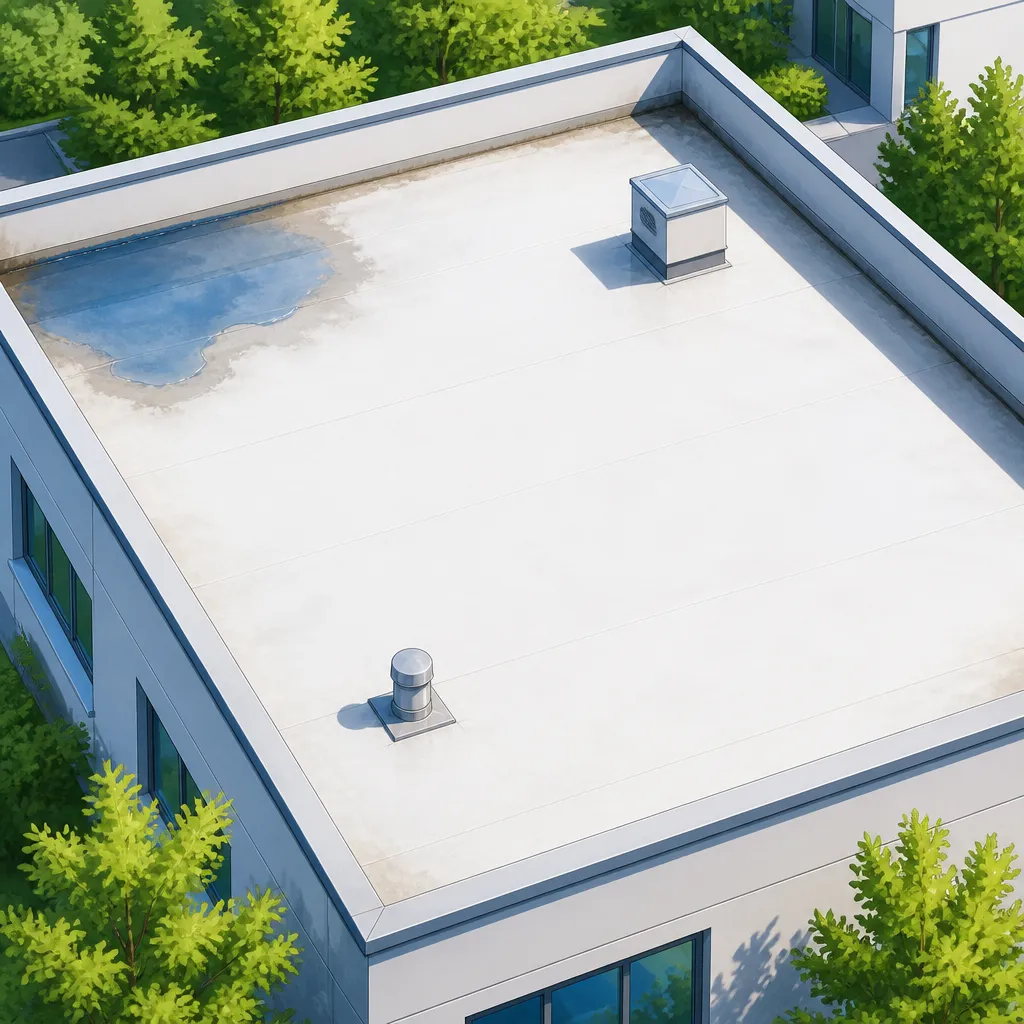
Before you ever call a contractor, you're already the first line of diagnosis. Most flat roof symptoms are visible from ground level with a pair of binoculars, from a nearby second-story window, or with a quick trip up a low stepladder to the roof's edge. You don't need to walk the surface to know something's wrong—you just need to know what you're looking for.
Flat roof problems tend to fall into three categories. Water-related issues show up as ponding or staining, usually darker patches that linger after rain. Membrane damage shows up as blisters, cracks, or soft spots where the TPO has lost its structural integrity. Seam issues show up as visible gaps, lifted edges, or peeling at the joints where two sheets of membrane were welded together. Learning to sort what you see into one of these three buckets is the first real step toward fixing a flat roof correctly instead of guessing.
Florida's climate complicates this. Intense UV exposure breaks down TPO membrane faster than in cooler, drier climates. Humidity traps moisture beneath the surface even when it hasn't rained in days. And the daily swing between scorching afternoon heat and cooler nights causes constant expansion and contraction that stresses seams and aging membrane. A roof that might last 25 years in a temperate climate often shows wear here within 15 to 18.
One simple test tells you a lot: if water is still sitting on your roof 48 hours after rain stops, with no active storm in the forecast, that's a red flag—even if you don't see an active leak yet. Standing water that long means drainage isn't working as designed, and the membrane underneath is absorbing more UV and heat stress than it should.
- Always inspect from a safe vantage point (ground level or low ladder)—don't walk on the roof if you're untrained; wet or degraded membrane can slip.
- Take dated photos or video of any suspicious area; contractors use these for baseline assessments and insurance claims.
- Note the time and weather—ponding water may appear after heavy rain but disappear within hours on hot days, which affects urgency.
For a more structured approach to documenting what you find, our pre-arrival checklist to document issues faster walks through exactly what to capture before a roofer ever sets foot on your property.
2. Ponding Water on Your Flat Roof: Drainage Problem or Membrane Leak?
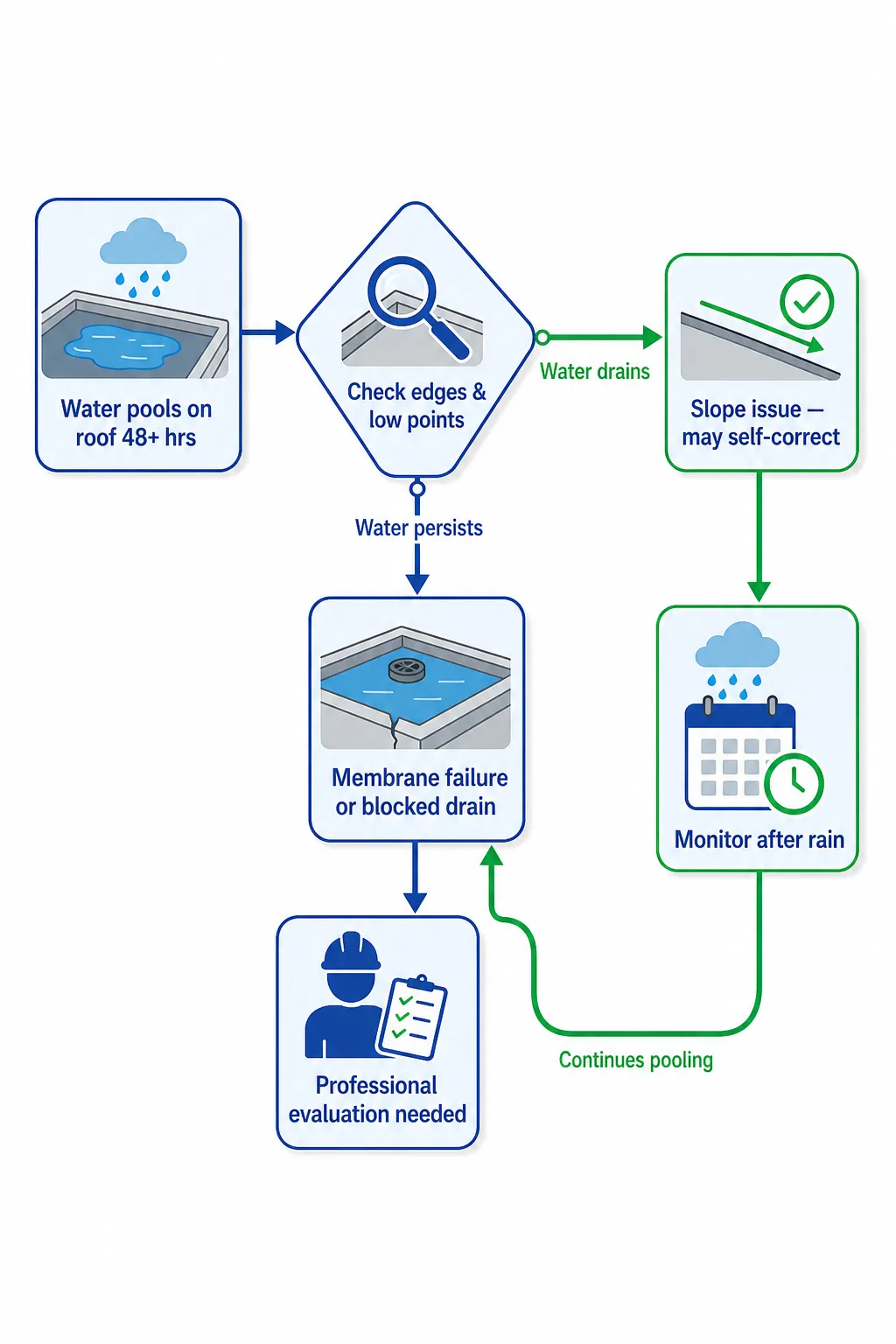
Ponding water is defined by roofing standards as water that remains on the surface for more than 48 hours after rainfall. It matters because stagnant water accelerates UV damage at the membrane surface and creates the conditions for micro-cracks to form over time, even on a roof that isn't leaking today.
In Florida, ponding usually traces back to one of three root causes. Poor slope is rare on newer installations but shows up on older structures that have settled unevenly over the years. Blocked roof drains—clogged with leaves, pine needles, or algae growth—are by far the most common culprit. And sometimes the problem isn't on the roof at all; it's a downspout or interior drain line that's backed up below the surface, causing water to back up onto the membrane instead of draining away.
Here's the good news: not all ponding requires a replacement. A surprising number of cases are solved with a simple drain cleaning or a minor slope correction—work that can often be completed in a day or two. The trick is telling the difference between a drainage fix and an actual membrane failure. If water that was ponding eventually evaporates during a dry stretch and the roof shows no staining underneath, you're likely looking at a slope or drainage issue rather than a leak. If water persists regardless of weather, or you start seeing interior stains, that points toward membrane failure.
- Clear roof drains and gutters before heavy rain season; debris blocks water flow and creates artificial ponding.
- If you see green algae or moss growth in pooled areas, it's a sign water is sitting for extended periods—don't ignore it.
- Ponding is easier to fix than a full roof replacement, but delaying creates secondary damage (blistering, seam stress) that costs more later.
3. TPO Roof Blisters and Alligatoring: When to Repair and When to Replace
A blister is a pocket of trapped air or moisture that got caught beneath the TPO membrane, usually during installation, and expands as the surface heats up. In Sarasota's summer, where roof surface temperatures routinely climb well past 90°F, that trapped air expands more aggressively than it would in a milder climate, pushing the membrane upward into a visible, raised bump. Unlike some roofing materials, TPO doesn't "breathe" in a way that lets that trapped moisture slowly escape, so once a blister forms, it tends to stay.
Not every blister is an emergency. A small, intact blister—one that hasn't cracked or split open—may never cause a leak at all. The membrane is still doing its job of keeping water out; it's just cosmetically imperfect. The moment that same blister develops a crack on its surface, though, the situation changes completely: water can now work its way underneath, and what was a non-issue becomes an active entry point for moisture.
This is also where TPO roofing diagnosis gets a bit more nuanced. Blistering is a series of discrete, isolated pockets. Alligatoring is something different and more serious—a widespread, interconnected cracking pattern across large sections of the membrane that signals advanced UV degradation. Think of blistering as a few bad spots and alligatoring as the whole surface losing its structural integrity at once.
To decide between repair and replacement, look at three factors together: what percentage of the surface is affected, how old the roof is, and whether active leaking has already started. The table below breaks down how those factors typically play out.
| Condition | Root Cause | Repair Option | Cost Range | When to Choose |
|---|---|---|---|---|
| Small intact blister (< 2 in. diameter) | Trapped air or moisture during installation | Monitor; repair only if cracking appears | $0–$300 | Roof < 15 years old, no spreading, no leaks yet |
| Multiple blisters or cracking surface | Widespread trapped moisture; membrane aging | Professional re-coating or isolated membrane replacement | $800–$3,000 | Blisters actively cracking or multiplying over 6–12 months |
| Severe alligatoring (widespread cracking pattern) | UV degradation + moisture + age; end-of-life failure | Full membrane replacement | $6,000–$12,000 | Roof 20+ years old or 40%+ of surface affected |
Consider what happened with a Sarasota homeowner whose 12-year-old TPO roof developed a 3-inch raised blister near the south edge. A roofer inspected it, found the blister intact with no cracking, and recommended monitoring for six months at no charge rather than jumping straight to a repair quote. Three months later, a hairline crack appeared on the blister's surface. The homeowner had it patched and re-coated for $400—saving roughly $5,600 compared to a full replacement. That roof is expected to run another five to eight years before replacement becomes necessary at all.
- Don't puncture a blister yourself; if it's not leaking, leaving it intact buys time for a planned repair.
- If you see blisters multiplying over 6–12 months, that signals ongoing moisture intrusion and warrants professional assessment sooner rather than later.
- Alligatoring is nearly always a replacement scenario because the entire membrane has lost structural integrity.
4. TPO Seam Failure: A Fixable Problem That Requires Expert Re-Welding
Think of your flat roof a bit like a boat hull. A single leaking seam doesn't mean you need a new boat—it means you need that seam re-caulked properly. TPO seam failure works the same way. A failed weld is a localized problem, not proof that the whole roof is failing, and it's almost always repairable by someone with the right equipment and training.
TPO sheets are joined using a hot-air welding process that fuses two pieces of membrane into a single, watertight bond. When that weld is done correctly, it's often stronger than the membrane itself. When it's done poorly—rushed during installation, under-heated, or given insufficient overlap—it becomes the weakest point on the entire roof. In Florida, constant UV exposure at seam edges and the daily thermal expansion-contraction cycle put extra stress on these joints, which is why seam failure tends to show up here more than in cooler climates.
The signs are usually easy to spot once you know to look for them: a lifted or peeling edge along a seam line, a visible gap where two sheets no longer meet cleanly, or a water stain that tracks in a straight line following the seam rather than spreading in a random blob. That linear pattern is the tell—it means water is entering at one specific point and following the path of least resistance.
A trained roofer can reheat the seam and re-bond it, restoring a watertight joint without touching the rest of the membrane. This is the part of fixing a flat roof that homeowners most often overpay for simply because they didn't know it was an option short of full replacement.
A single seam repair typically costs $200–$800 and takes two to four hours on a dry day—a fraction of the $6,000–$12,000 price tag for full replacement. That gap is exactly why it pays to get a proper diagnosis before assuming the worst.
- Seam failure often appears weeks or months after installation; don't assume it's a sign the roof is "bad"—it's usually a one-time fix under warranty if caught early.
- Have any seam issue inspected by a TPO specialist; DIY seam repair is not viable and voids manufacturer warranties.
- If multiple seams are failing, that suggests a larger installation problem and may indicate a full membrane replacement is more cost-effective.
Not every roofer is equipped to do this work correctly. If you want to understand how to hire a TPO specialist in Sarasota, that's worth reading before you book anyone for seam repair.
5. Repair vs. Replacement: A Cost-Benefit Framework for Your Roof's Remaining Life
TPO roofs in Florida's climate typically last 15 to 25 years. That range matters because it sets the baseline for every repair-versus-replace decision you'll make. If your roof is under 18 years old and the damage is isolated—a puncture, a single failed seam, a handful of blisters—repair almost always makes sense, both financially and practically.
This is the "extend versus rebuild" philosophy that experienced roofers use when they're being straight with you: targeted repairs can add three to five years of useful life to a roof, which gives you time to plan and budget for a full replacement instead of being forced into one by an emergency. There's real value in that breathing room, especially for property owners managing capital expenses across multiple buildings.
There's a point, though, where repair stops making financial sense. Once repair costs start approaching roughly half of what a full replacement would cost, the math shifts toward replacement—you're spending significant money to patch a roof that's going to need replacing soon anyway. It's also worth understanding the warranty implications: a repair generally preserves whatever remaining warranty your roof has, while a full replacement resets the clock entirely with a new warranty period.
Finally, factor in cash flow. Can you afford a modest repair now and plan for replacement in three to five years, or does it make more long-term sense to handle the bigger expense today? There's no universally right answer—it depends on your budget, your roof's actual condition, and how much risk you're comfortable carrying.
| Scenario | Roof Age | Problem Type | Repair Cost | Replacement Cost | Best Choice |
|---|---|---|---|---|---|
| Single TPO puncture | 5–12 years | Isolated hole or tear | $200–$600 | $6,000–$12,000 | Repair |
| Localized seam failure | 2–8 years | 1–2 failed welds | $300–$800 | $6,000–$12,000 | Repair |
| Widespread blistering | 12–18 years | >25% of surface cracking | $1,500–$3,000 | $6,000–$12,000 | Repair (buys 3–5 more years) |
| Advanced alligatoring + multiple leaks | 20+ years | Extensive UV damage, >40% affected | $3,000–$5,000 (temporary) | $6,000–$12,000 | Replacement (structural failure imminent) |
- Get multiple quotes for both repair and replacement; contractors sometimes push replacement even when repair is viable.
- Ask about lifetime warranties on repairs—some roofers offer them, adding value to the decision.
- If your roof is approaching 20+ years, budget for replacement within 1–2 years even if repairs are working today; failure can accelerate.
6. How to Prepare for a Flat Roof Repair Contractor Visit
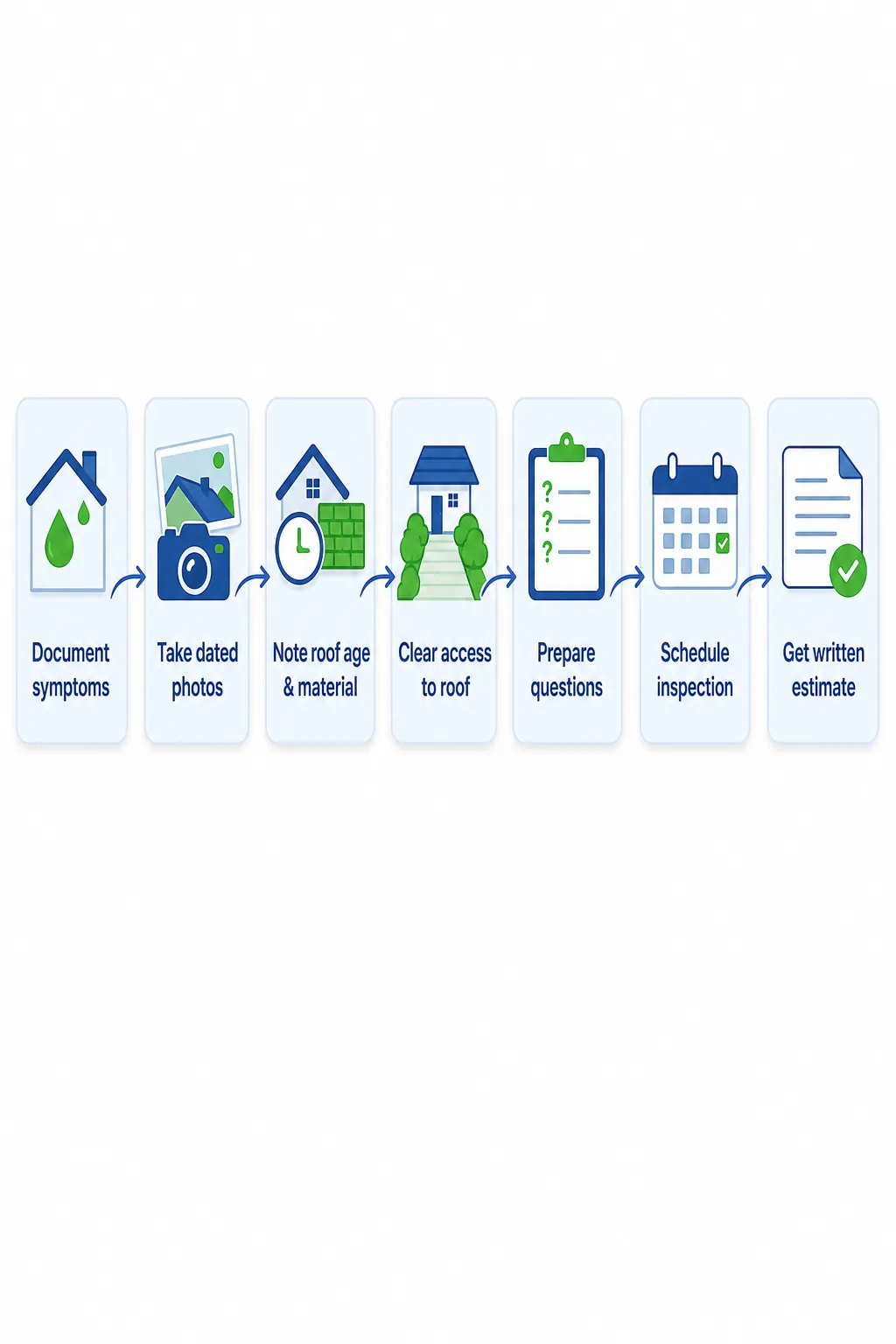
Once you've identified the problem and decided it's time to call a flat roof repair near me, a little preparation goes a long way toward getting an accurate, efficient estimate. Start by pulling together whatever paperwork exists: your roof's original warranty documents, any previous repair records, and the installation date, which you can usually find in title documents or by contacting the original builder.
Dated, timestamped photos matter more than most homeowners realize. When a contractor can see exactly when ponding water appeared, how a blister has changed over several months, or where a seam issue first showed up, they can assess severity without having to guess—or without padding the estimate "just in case."
Make sure the roof is actually accessible before the contractor shows up. Clear gutters, move any outdoor furniture or equipment off the roof surface, and identify clear entry points. A roofer who has to spend the first hour of a visit just getting set up isn't doing billable repair work—that's wasted time that either costs you more or delays the job.
Come prepared with specific questions: Will this be a re-weld or a patch? Is the repair covered under my existing warranty? How long will the job take? And critically—what warranty does the contractor offer on the repair itself, separate from the manufacturer's material warranty? Finally, insist on a detailed written estimate that spells out the scope of work, materials used, labor hours, and a realistic timeline—not a vague line item that just says "roof repair."
- If you live in an HOA, notify the property manager before work begins; some require permits or advance approval.
- Schedule the repair for a dry forecast window; roofers cannot weld seams or apply coatings in rain or high humidity.
For a step-by-step version of this process, see our detailed pre-arrival checklist for faster roof repair.
7. Choosing a Local Flat Roof Repair Contractor: What to Vet in Sarasota & Manatee County
Not every contractor advertising "flat roof repair near me" is equally qualified to work on TPO roofing. Florida requires a valid state license to legally pull permits, and you can verify any contractor's license directly through the Department of Business and Professional Regulation (DBPR)—a step too many homeowners skip.
Licensing alone isn't enough, though. TPO-specific expertise matters because hot-air welding is a distinct skill set, not something every roofer trained on shingles or other membrane types knows how to do well. Ask directly about manufacturer-specific training—names like GAF, Versico, or Firestone come up often in this region—and whether they actually own and operate welding equipment, rather than subcontracting that part of the job.
Local experience in Sarasota and Manatee County carries real weight too. A contractor who's worked in this specific area understands local permitting requirements, is familiar with HOA quirks that can slow down a project, and has dealt firsthand with the coastal high-hazard zone designations that affect many properties here. Ask for references tied specifically to work done in this region—not just general roofing experience elsewhere.
Finally, get everything in writing: the repair warranty (industry standard runs one to five years), proof of current general liability insurance, and confirmation they're bonded for a project of your size. These aren't formalities—they're what protects you if something goes wrong after the crew leaves.
| Credential or Trait | Why It Matters | Red Flag | Green Flag |
|---|---|---|---|
| Florida roofing license | Legal requirement; only licensed roofers can pull permits | No license or evasive about licensing | License number verified with DBPR; active & current |
| TPO specialization | TPO requires specific hot-air welding skills; not all roofers are trained | Contractor claims to repair all roofs the same way | References to TPO-specific projects; owns welding equipment |
| Sarasota/Manatee experience | Local familiarity with permitting, HOA quirks, and climate challenges | Out-of-area contractor unfamiliar with local building codes | 5+ years in the area; understands coastal high-hazard zones |
| Written warranty on repair | Protects you if the repair fails; industry standard is 1–5 years | No warranty offered or "warranty only on materials" | 2–5 year warranty on labor and materials; put in writing |
| Insurance and bonding | Covers liability if you're injured; proves financial stability | No general liability or unable to provide proof | Current GL insurance; bonded for contract work |
- Never pay the full quote upfront; standard practice is 50% down and 50% on completion.
- If a contractor offers a "too good to be true" price, it often means shortcuts on materials or labor—verify their reputation with past clients.
- Ask for a timeline in writing; delays in Florida often stem from weather, but a pro contractor should have a buffer plan.
For more on this, read how to hire the right commercial roofer in your area and our broader guide to vetting local roofers near you in Sarasota and Manatee County.
What This Means for Sarasota Property Owners
- Early diagnosis of flat roof issues can defer replacement by 3–5 years, allowing for better budgeting and timing.
- Understanding the difference between drainage problems, membrane damage, and seam failure shifts the narrative from "time for a new roof" to "time for a targeted repair"—a mindset change that saves money and stress.
- Florida's harsh climate means regular inspections (annually or after major storms) are not optional for flat roof owners; prevention is far cheaper than emergency repairs.
- Local contractor expertise matters: a roofer trained in TPO hot-air welding, familiar with Sarasota's permitting quirks, and bonded for residential or commercial work is worth the investment over a cut-rate out-of-area bid.
Frequently Asked Questions
How much does flat roof repair near me typically cost in Sarasota?
It depends entirely on what's wrong. A single TPO puncture or seam re-weld usually runs $200–$800, while widespread blistering or multiple failed seams can run $1,500–$3,000. Full replacement, by comparison, typically costs $6,000–$12,000, which is why accurate diagnosis matters so much before you commit to a quote.
Can I repair a flat roof myself?
Minor monitoring—like photographing a small, intact blister or clearing debris from a drain—is safe to do yourself. But actual repair work, especially TPO seam welding, requires specialized heat-welding equipment and training. DIY seam repairs typically void manufacturer warranties and often fail within months.
Is ponding water on my flat roof always a sign of a leak?
Not necessarily. Ponding water that lasts more than 48 hours is often a drainage or slope issue rather than an active leak. That said, leaving it unaddressed accelerates UV damage and can eventually cause the membrane to fail, so it shouldn't be ignored even if there's no visible leak yet.
How long does TPO roofing typically last in Florida's climate?
Most TPO flat roofs last 15 to 25 years, but Florida's intense UV exposure, humidity, and heavy rainfall tend to push lifespans toward the shorter end of that range compared to cooler, drier climates. Regular inspections and prompt small repairs can help you get closer to the upper end.
How do I know if I need a repair or a full roof replacement?
Generally, if your roof is under 18 years old and the damage is isolated—a single puncture, one failed seam, a handful of blisters—repair is the smarter financial choice. Replacement becomes the better option once repair costs start approaching roughly half the cost of a full replacement, or when more than 40% of the surface shows advanced cracking (alligatoring).
Keep Learning
- Commercial Roofers Near Me: How to Hire the Right Contractor in Sarasota & Manatee County — Deep dive into vetting commercial roofing contractors, TPO expertise, and flat roof-specific credentials in your region.
- Residential Roofers Near Me in Sarasota & Manatee County: What Sets Them Apart — Understand licensing, local permitting, and HOA compliance for residential flat roof repairs in Sarasota.
- Top Roofers Near Me in Sarasota & Manatee County: How to Vet Local Contractors — A comprehensive vetting guide focusing on reputation, experience, and warranty transparency for local roofers.
- Roof Fixers Near Me: A Pre-Arrival Checklist for a Faster Fix — Step-by-step checklist to prepare your home and documentation before a roofer arrives, speeding up diagnosis and reducing surprises.
- Storm Damage Roof Repair Near Me: Sarasota & Manatee County Homeowner's Guide — Learn how to document and respond to hurricane or weather damage on flat roofs, including insurance and contractor selection.
- Roof Replacement Cost in Sarasota: A 2026 Price Guide — Current pricing for flat roof replacement, how coastal high-hazard zones affect costs, and long-term budget planning for Sarasota homeowners.